Risk Management
THC has set a long-term goal with stable and sustainable development to set up a "Risk Management Policy and Procedure", all departments carry out potential risk identification, and assessment of the environmental, social and corporate governance issues affecting the Company’s operations. All employees are responsible for comprehensive risk management to set up defenses through daily routines. THC has formed a crisis management team to immediately carry out appropriate actions and execute relevant plans in response to a risk loss occurring, ensuring the survival of the Company and resuming normal production and business activities soon.
The Company passed "Risk Management Policy and Procedure” on March 22, 2022, formulating the guidelines for the assessment of the risk of the environmental, social, and corporate governance issues that may affect the operation of the Company and relevant countermeasures. At least once a year, report to the Board of Directors on the status of the risk management.
To enhance the Company’s sustainability performance and strengthen the overall risk management mechanism, the Board resolved on May 9, 2025, to expand the mandate and responsibilities of the original“Sustainability Development Committee,” officially renaming it the “Sustainability and Risk Management Committee.”
On March 6, 2026, the 2025 Annual Risk Management Report was presented to the Board, detailing the auditing and identification of risk assessments across all departments, alongside the implementation of appropriate mitigation measures.
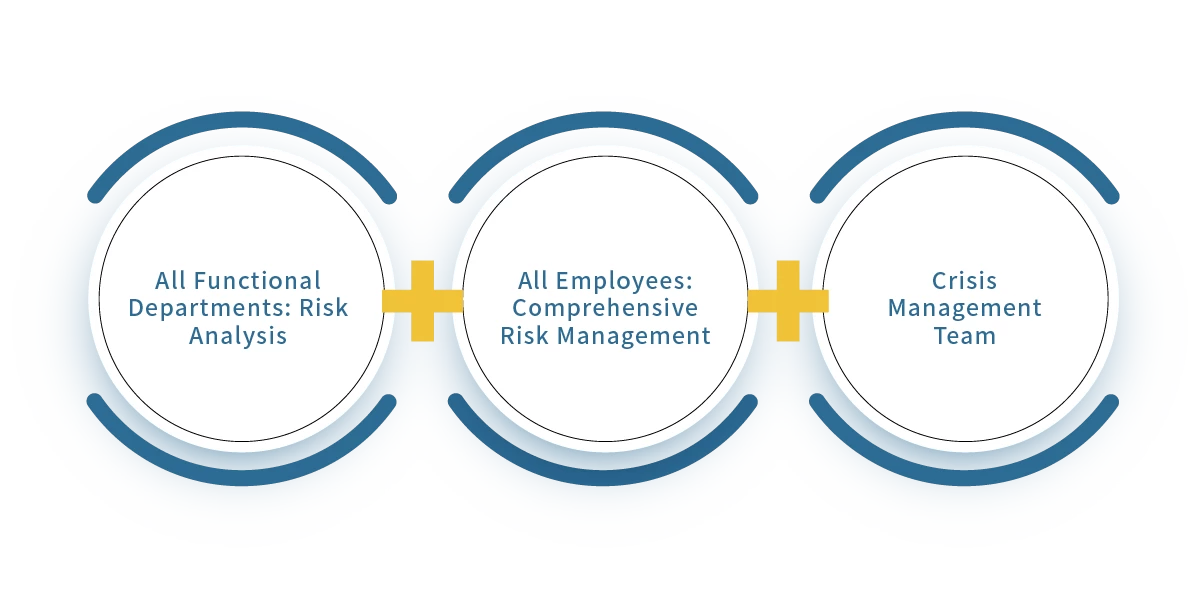
Risk Identification and Management Procedures
The following table reports the risk management implementation status to the Sustainability and Risk Management Committee for 2025:
Risk Category: Market
| Risk Item | Risk Description | Current Control Measures | Tracking Unit |
|---|---|---|---|
| Key Client Dependency | High concentration of major brand clients, which could severely impact the company's revenue and reputation if a client adjusts its strategy, is lost, or is involved in a scandal. |
|
Business Dept. |
Risk Category: Operational
| Risk Item | Risk Description | Current Control Measures | Tracking Unit |
|---|---|---|---|
| Product Quality and Food Safety | Product quality anomalies or food safety incidents resulting in customer claims, large-scale recalls, or loss of FSSC 22000 certification. |
|
Quality Assurance Dept. |
| Information Security | Hacker attacks, ransomware, or system outages leading to operational shutdown or the leakage of confidential data. |
|
IT Dept. |
| Environmental Pollution Liability | Interruption of key raw material supply (e.g., PET, PP) due to geopolitics or pandemics, affecting production and order delivery. |
|
Procurement Dept. |
| Occupational Safety and Health (OSH) | Falls, crushing, collisions, or burns due to equipment operation, working environment, or human negligence. Aging or abnormal equipment lines or improper maintenance resulting in leaks, causing fire, explosion, production interruption, and personnel injury/death. |
|
Occupational Health Safety Center |
Risk Category: Environmental
| Risk Item | Risk Description | Current Control Measures | Tracking Unit |
|---|---|---|---|
| Climate Change and Transition (Carbon Fee/Tax) |
The implementation of domestic and international carbon pricing mechanisms (e.g., Taiwan's carbon fee) will significantly increase operating costs, affecting product pricing and market competitiveness. |
|
Sustainable Development Dept. |
| Water Resources and Wastewater Discharge | Operational sites (especially in overseas regions) facing seasonal or permanent water shortages or government water restrictions, affecting production. Wastewater discharge exceeding standards leading to fines and environmental pollution liability. |
|
Sustainable Development Dept. Occupational Health Safety Center |
| Waste (Water) and Air Pollution | Failure to comply with regional environmental regulations for wastewater and waste treatment, or failure to meet waste recycling rate targets, leading to fines or suspension of work. |
|
Sustainable Development Dept. Occupational Health Safety Center |
Risk Category: Human Rights and Business Ethics
| Risk Item | Risk Description | Current Control Measures | Tracking Unit |
|---|---|---|---|
| Labor Rights and Talent Retention | Workplace discrimination, migrant worker rights (zero-fee controversy), or inability to retain key talent, affecting corporate reputation and operational efficiency. |
|
HR Dept. |
| Integrity Management and Anti-Corruption | Fraud, corruption, or insider trading incidents, affecting corporate reputation and shareholder equity. |
|
HR Dept. |
Risk Category: Financial
| Risk Item | Risk Description | Current Control Measures | Tracking Unit |
|---|---|---|---|
| Exchange Rate Fluctuation | Overseas subsidiaries mainly focus on the local domestic market, with receipts and payments primarily in local currency. The main gain/loss from exchange is from the translation gain/loss of financial assets and liabilities denominated in foreign currencies. | Adopt a natural hedging strategy, using foreign currency liabilities to balance foreign currency assets. Observe international finance and exchange rate changes, and engage in hedging for the net position of foreign currency-denominated financial assets and liabilities according to the "Procedures for Engaging in Derivative Product Transactions" to appropriately mitigate the risk of exchange rate changes. | Finance Dept. |


